Medicare Coverage for People Receiving Social Security Disability Benefits

If you receive Social Security Disability Insurance (SSDI), health coverage is probably one of your biggest questions. Medicare may become part of the answer, but it does not start the day your disability benefits do. There is a waiting period, a few exceptions, and several choices to make along the way. Knowing the timeline early helps you avoid coverage gaps.
This guide explains Medicare Social Security Disability benefits in plain language, from when coverage begins to what you can do while you wait. If you want Medicare enrollment assistance in Georgia, Value Financial Protection, a Georgia insurance agency, can help you review your options.
Key Terms in Plain Language
- SSDI: monthly benefits for people who cannot work because of a disability and have enough work history
- Original Medicare: Part A (hospital) and Part B (medical)
- Part D: prescription drug coverage from a private plan
- Medicare Advantage: a private plan that replaces Original Medicare
- Medigap: extra insurance that helps pay Original Medicare costs
Who Qualifies for Medicare with SSDI?
You generally qualify for Medicare after you have received SSDI benefits for 24 months. Social Security counts one month for each month you are entitled to benefits, so the clock starts when your benefits begin, not when your condition began.
Most people qualify through SSDI, but there are other paths:
- SSDI for 24 months: the most common route
- ALS: Medicare generally starts the first month you receive disability benefits, with no 24-month wait
- Kidney failure (ESRD): separate Medicare rules apply that do not depend on SSDI
SSI is different. Medicare through disability is tied to SSDI, while Supplemental Security Income (SSI) is a needs-based program that usually leads to Medicaid instead, as the National Council on Aging explains.
How Long Is the Wait, Really?
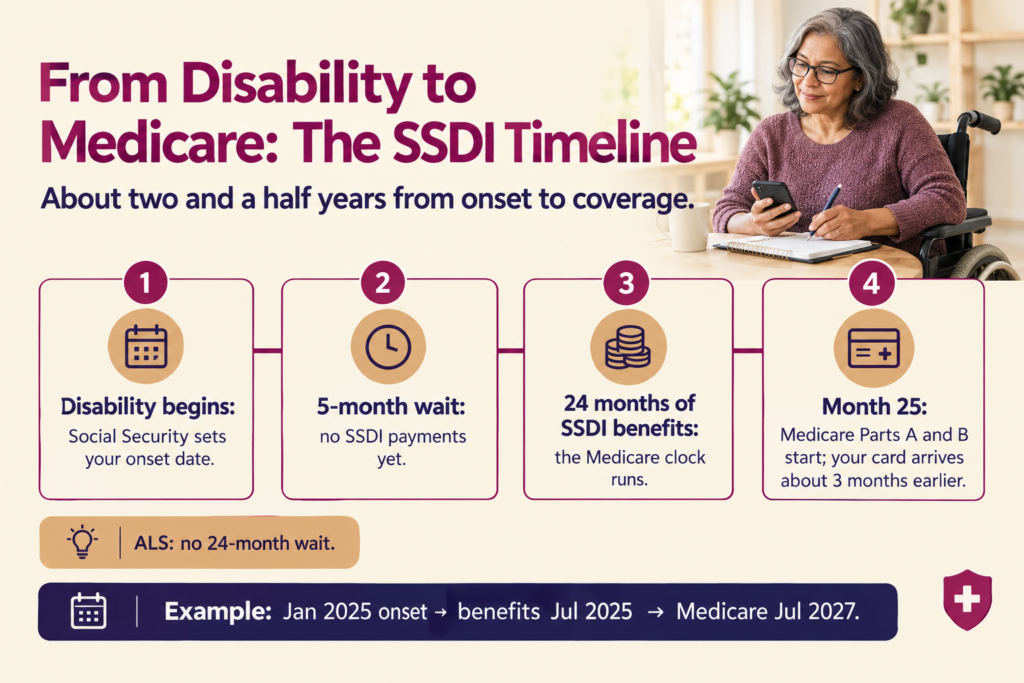
The 24 months begin only after SSDI payments start, and SSDI itself has a five-month waiting period. Social Security says benefits begin in the sixth full month after the date it finds your disability began. For many people, that means roughly two and a half years from onset to Medicare.
Step | What Happens |
|---|---|
Disability begins | Social Security sets your onset date |
Five-month wait | No SSDI payments yet, skipped for ALS |
Benefits begin | This is month 1 of your 24 months |
About 3 months before month 25 | Your Medicare card arrives in the mail |
Month 25 | Medicare Parts A and B start |
For example, if Social Security finds your disability began in January 2025, benefits would begin in July 2025 and Medicare would start in July 2027. Months covered by back payments still count toward the 24.
What to Do While You Wait
Two years is a long time without coverage, so many people use other options in the meantime:
- Coverage through a current or former employer
- A spouse’s health plan
- Medicaid, if your income and resources are limited
- An Affordable Care Act plan
Whichever you choose, ask how it will work once Medicare begins.
How You Get Enrolled
For most people, Medicare Social Security Disability benefits start automatically. According to Medicare.gov, Social Security enrolls you in Original Medicare after 24 months, which means Part A (hospital) and Part B (medical). You do not need to sign up.
A few decisions are still yours:
- Part B premium: Part B has a monthly premium, usually deducted from your Social Security payment
- Part B timing: declining Part B without other qualifying coverage can mean a late penalty later, so Medicare Part B enrollment assistance can help you weigh the choice
- Employer coverage: if you or a spouse still has job-based coverage, you may be able to delay Part B without a penalty
- Drug coverage: Parts A and B do not include most prescriptions, so most people add a Part D plan or choose Medicare Advantage
What Medicare Covers and What It Does Not
Original Medicare has two parts:
- Part A: inpatient hospital stays, skilled nursing facility care, hospice, and some home health services
- Part B: doctor visits, outpatient care, preventive services, and some medical equipment
Equipment such as wheelchairs and walkers may be covered when Medicare’s requirements are met, but approval is not automatic for every item. Original Medicare also leaves deductibles and coinsurance to you and generally does not cover routine dental, vision, or hearing care.

What Medicare Costs
- Part A: premium-free when you qualify through SSDI
- Part B: a monthly premium, with a standard amount of $202.90 in 2026, though some people pay less or get help
- Out-of-pocket costs: deductibles, copayments, and coinsurance still apply
Original Medicare or Medicare Advantage?
You can keep Original Medicare or join a Medicare Advantage plan, which is run by a private insurer and must cover what Original Medicare covers. To join, you need both Part A and Part B, according to Medicare.gov.
When comparing Medicare Advantage plans in Georgia, check networks, referrals, prior authorization, and yearly out-of-pocket limits. With Original Medicare, prescription drug plan enrollment is a separate step, and Extra Help may lower drug costs if your income and resources are limited.
Some Advantage plans, called Special Needs Plans, are designed for people with certain conditions or with both Medicare and Medicaid. Availability depends on where you live.
Before choosing any plan, ask:
- Are my doctors in-network?
- Is each of my medications covered, and at what cost?
- Are my equipment suppliers covered?
- What is the yearly out-of-pocket limit?
Medigap for People Under 65 in Georgia
Medigap, also called Medicare Supplement Insurance, helps pay costs that Original Medicare does not. Federal law generally does not require insurers to sell it to people under 65, according to Medicare.gov.
Georgia is an important exception. Insurers that sell Medigap to people 65 and older must also offer it to people under 65 who have Medicare because of a disability, as HealthInsurance.org explains. Compare Medicare Supplement plans in Georgia carefully, because premiums for younger buyers may be higher. You also get a new six-month Medigap window when you turn 65. Medigap works with Original Medicare, not with Medicare Advantage.
Help Paying for Medicare
Several programs can lower your costs if your income and resources are limited:
- Medicaid: people who receive SSI usually qualify, and some people have both Medicaid and Medicare
- Medicare Savings Programs: help pay Medicare premiums and sometimes other costs
- Extra Help: lowers Part D premiums and drug costs
- QDWI: may help with the Part A premium for some people who return to work
Georgia SHIP offers free counseling at 1-866-552-4464, option 4.
If You Go Back to Work
Returning to work does not automatically end your Medicare Social Security Disability benefits. As long as your condition still meets Social Security’s rules, you can keep premium-free Part A for at least 93 months after your trial work period, about 7 years and 9 months, according to Social Security. Part B continues too, and you keep paying its premium. Report any change in your work activity promptly so Social Security can tell you how long your coverage will continue.
If you have employer coverage, who pays first depends on company size. For a disability, Medicare usually pays first at employers with fewer than 100 employees, while a large group plan pays first at employers with 100 or more.

How It Can Play Out
- A long approval: someone whose claim takes a year may reach Medicare sooner after approval, because back-payment months count
- An ALS diagnosis: Medicare can begin in the first month of benefits
- Part-time work: someone with employer coverage may delay Part B and sign up later
Common Misunderstandings
- “Medicare starts when I am approved.” It starts after the waiting period.
- “SSI and SSDI both lead to Medicare.” Medicare is tied to SSDI.
- “Medicare covers everything.” Costs and coverage gaps still apply.
- “If I work, I lose Medicare.” Not necessarily.
Your Next Steps
- Find your entitlement date on your benefit letter
- Count 24 months and mark month 25
- Watch for your Medicare card about three months earlier
- Make a list of your doctors and medications
- Decide how you will cover prescriptions
- Keep copies of notices from Social Security and Medicare
- Ask whether job-based coverage affects Part B timing
- Call Social Security at 1-800-772-1213 or 1-800-MEDICARE with questions
Family members who help with paperwork may also look for caregiver support for Medicare decisions .

Get Clear Answers on Medicare Social Security Disability Benefits from Value Financial Protection
Timing, enrollment choices, and Medigap rules can feel confusing when you are also managing a disability. At Value Financial Protection, our licensed Advisors provide no-cost guidance in plain language. We can schedule a Medicare consultation in Georgia to review your timeline, your doctors, and your medications.
To speak with a Medicare advisor in Georgia, call 678-449-7197 or reach us through our contact page. If you want to compare Medigap plans in Snellville, GA, we also serve Gresham Park, Lilburn, Atlanta, Druid Hills, Monroe, Decatur, Tucker, Stockbridge, Loganville, Covington, and Redan.
Disclaimer: We do not offer every plan available in your area. Any information we provide is limited to those plans we do offer in your area. Please contact Medicare.gov or call 1-800-MEDICARE to get information on all your options.
Confidentiality Disclaimer: IMPORTANT NOTICE REGARDING CONFIDENTIALITY: This e-mail and any files attached to it may contain CONFIDENTIAL information, including encrypted PRIVATE AND CONFIDENTIAL HEALTH INFORMATION. All such information is intended ONLY for the use of the person or entity to which it is addressed. If you are not the intended recipient of this e-mail and/or any attachment, or an employee/agent responsible for delivering it to the intended recipient, you are hereby notified that any dissemination, distribution, reproduction, reading, or copying of this information is STRICTLY PROHIBITED. If you have received this e-mail in error, please delete the related e-mail and any attachments.