Medicare and Preventive Care: What Services Are Covered?

When was your last screening, vaccine, or wellness check-up? Many people with Medicare are unsure which services they can use or what those services may cost. Medicare preventive care can help find health problems early and prevent certain illnesses, and most of it comes at no out-of-pocket cost when the provider accepts assignment.
For Georgia residents, knowing what is covered, and when, makes it easier to plan appointments and avoid surprise bills. This guide explains the main services Medicare covers, how the Welcome to Medicare and yearly wellness visits work, which screenings and vaccines are included, and where costs can still apply.
What Counts as Preventive Care Under Medicare?
According to Medicare.gov, preventive services include exams, vaccines, lab tests, screenings, health-monitoring programs, and counseling or education that help you manage your health. Most are covered by Part B, and you generally pay nothing when your provider accepts assignment.
A test ordered to investigate symptoms or abnormalities is diagnostic rather than preventive. Diagnostic care follows different cost rules, as the mammogram example later in this guide shows.
Do You Need Part B to Use These Services?
Yes. Preventive services are Part B benefits, so Part A alone does not cover them. If you delay Part B, for example because you still have job-based coverage, you may also delay access to these services. Part B has a monthly premium, so weigh the timing carefully.
Start With the Welcome to Medicare Visit
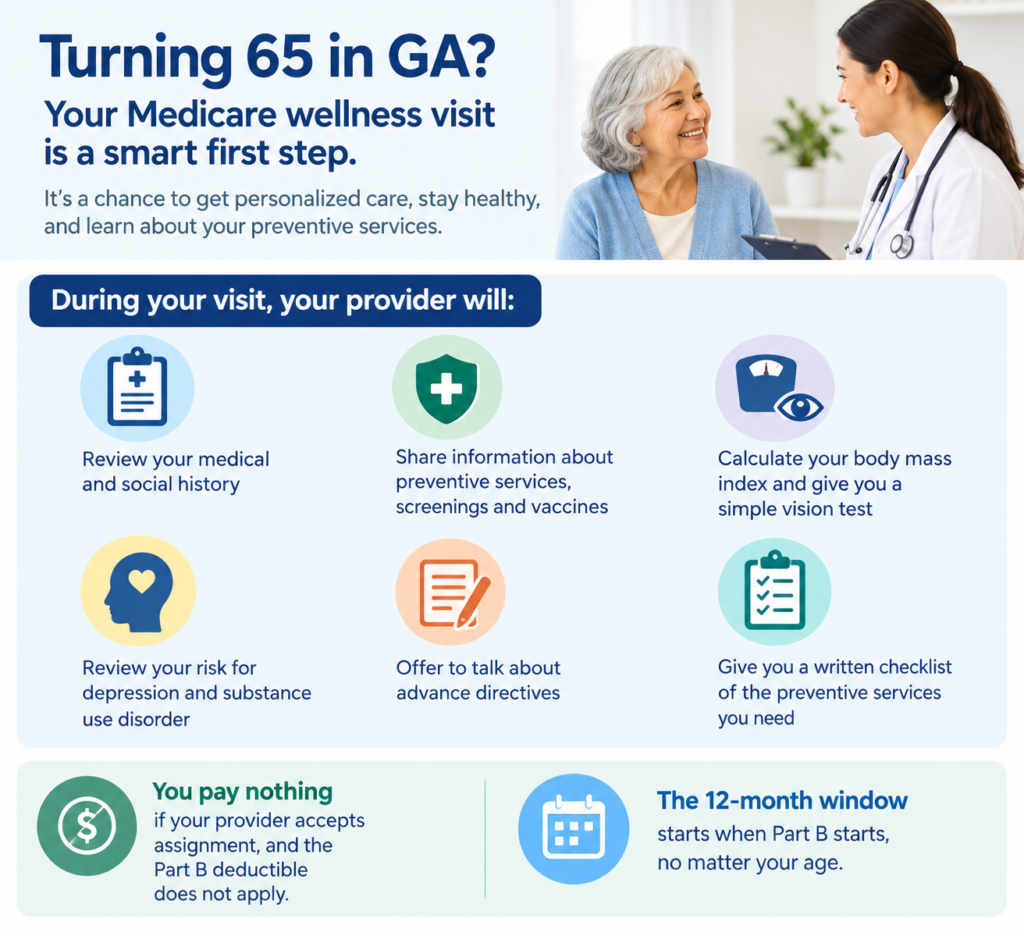
The Welcome to Medicare visit is a one-time preventive check-up covered once within the first 12 months you have Part B. It is not a comprehensive physical exam. For anyone exploring Medicare options for seniors turning 65 in GA, it is a useful first appointment to schedule.
During the visit, your provider will:
- Review your medical and social history
- Share information about preventive services, screenings, and vaccines
- Calculate your body mass index and give you a simple vision test
- Review your risk for depression and substance use disorder
- Offer to talk about advance directives
- Give you a written checklist of the preventive services you need
You pay nothing if your provider accepts assignment, and the Part B deductible does not apply. The 12-month window starts when Part B starts, no matter your age.
Yearly Wellness Visits After the First Year
Medicare also covers a yearly wellness visit once every 12 months. It is a conversation-based visit to create or update a personalized prevention plan, not a routine physical exam. Your first yearly visit cannot take place within 12 months of enrolling in Part B.
Expect a Health Risk Assessment questionnaire, routine measurements such as height and blood pressure, a review of your prescriptions, and a cognitive assessment. Because both visits depend on Part B, people unsure when their coverage began may want Medicare Part B enrollment assistance in GA to confirm their dates.
Bring these items to your appointment:
- Medical records, including immunization records
- Your family health history
- A list of prescriptions, over-the-counter drugs, vitamins, and supplements
For example, imagine someone who starts Part B in March and has a Welcome to Medicare visit in June. Their first yearly wellness visit cannot happen until the following June, because 12 months must pass after both dates.
Screenings Medicare Covers
Part B covers a wide range of screenings. Based on Medicare.gov’s list, they fall into these groups:
- Cancer: mammograms, colorectal tests, lung cancer, prostate, and cervical and vaginal screenings
- Heart and metabolic health: cardiovascular and diabetes screenings, diabetes self-management training, and the Medicare Diabetes Prevention Program
- Bone, vision, and vascular health: bone mass measurements, glaucoma, and abdominal aortic aneurysm screenings
- Infections: hepatitis B, hepatitis C, HIV, and sexually transmitted infection screenings
- Behavioral health: depression screening, alcohol misuse and tobacco-use counseling, obesity behavioral therapy, and medical nutrition therapy

Eligibility and frequency vary by service. These three examples come from Medicare.gov’s pages on mammograms, colonoscopies, and lung cancer screening:
| Screening | Who and How Often | Your Cost |
| Screening mammogram | Women 40 and older, every 12 months | $0 if provider accepts assignment |
| Screening colonoscopy | No minimum age; every 120 months, or every 24 if high risk | $0, but 15% if a polyp is removed |
| Lung cancer screening | Ages 50–77 with a 20 pack-year smoking history, current smoker or quit within 15 years; yearly with a provider’s order | $0 if provider accepts assignment |
Support Beyond Screenings
Preventive care is not only about tests. Medicare also covers counseling and education programs, including:
- Tobacco-use counseling and alcohol misuse screenings and counseling
- Obesity behavioral therapy and medical nutrition therapy
- Diabetes self-management training and the Medicare Diabetes Prevention Program
Your yearly wellness visit also includes a cognitive assessment. If your provider sees signs of cognitive impairment, Medicare covers a separate visit for a more thorough review of your thinking and memory, including a check for conditions such as dementia, depression, anxiety, or delirium.
When Preventive Care Can Still Cost You Money
“No cost” applies to the preventive service itself. Costs can appear when:
- The provider does not accept assignment
- Extra tests are added during a preventive visit, which may bring coinsurance and the Part B deductible
- A service is not covered, such as a routine physical exam, and you owe the full amount
- A screening becomes diagnostic, such as a diagnostic mammogram, which carries 20% coinsurance after the deductible
- A polyp is removed during a screening colonoscopy, which carries 15% coinsurance
Before any appointment, ask the provider’s office what Medicare covers, how often, and what you may owe.
Questions to Ask Before You Book
- Do you accept Medicare assignment?
- Is this visit preventive or diagnostic?
- How often does Medicare cover this service?
- Will any extra tests be added, and what might they cost?
Vaccines: Part B and Part D
Vaccines are covered under two different parts of Medicare, so your drug coverage matters:
- Part B: flu shots once per flu season, pneumococcal, COVID-19, and hepatitis B for people at medium or high risk
- Part D: other recommended adult vaccines, such as shingles, RSV, and Tdap

The National Council on Aging notes that Part D plans have covered recommended adult vaccines with no cost sharing since 2023. A person with only Original Medicare may therefore lack Part D vaccine coverage, which is one reason to review Medicare Part D plans in Georgia. Recommendations can change, so confirm current guidance with your provider. If a pharmacy gives you a Part D vaccine, make sure it bills your Part D plan.
Original Medicare and Medicare Advantage
With Original Medicare, you receive preventive care from providers who accept Medicare. Medicare Advantage plans must cover everything Original Medicare covers, including preventive services, but they may use networks, referrals, or prior authorization. Many also add extras such as dental, vision, or hearing.
When comparing Medicare Advantage plans in Georgia, check whether your primary care provider and screening facilities are in-network and whether extra benefits fit your needs. For example, a plan may use specific imaging centers, so confirm your usual facility participates before booking a screening.
Common Misunderstandings
- “My wellness visit is my yearly physical.” It is not. Routine physical exams are not covered.
- “If my doctor recommends it, Medicare covers it.” Not always. A service may be uncovered or offered more often than Medicare allows.
- “Medicare Advantage skips preventive care.” These plans must cover what Original Medicare covers.
How to Get the Most From Your Preventive Benefits
- Tell the office which visit you are scheduling
- Ask for your written prevention plan and keep it with your records
- Track when each screening was last done, since coverage is limited by frequency
- Confirm that your provider accepts assignment
- Review vaccine coverage under both Part B and Part D
Plans and costs can change each year, so the open enrollment period from October 15 to December 7 is a good time to review coverage. Medicare open enrollment help can make that review easier.
Family members who manage a parent’s appointments may also look for caregiver support for Medicare decisions in Georgia, especially when tracking screenings, vaccines, and wellness visits.

Medicare Preventive Care Guidance from Value Financial Protection
Preventive care works best when you understand your coverage before the appointment. At Value Financial Protection, our licensed advisors provide no-cost guidance on Part B, Part D, and Medicare Advantage options in plain language. We can help you review your current coverage and prepare questions to discuss with your providers.
If you have questions about your Medicare options and want to speak with a Medicare advisor in Georgia, reach out to our team. We serve communities throughout the area, including Lilburn, Atlanta, Duluth, Monroe, Decatur, Tucker, Stockbridge, Loganville, Snellville, Covington, Redan, and those seeking Medicare help.
Our guidance is based on your circumstances, not a one-size-fits-all checklist. We can explain the plans we represent and help you understand your options, while encouraging you to compare plans at Medicare.gov as well.
Disclaimer: We do not offer every plan available in your area. Any information we provide is limited to those plans we do offer in your area. Please contact Medicare.gov or call 1-800-MEDICARE to get information on all your options.